

It's very important language?Yes it is!.
How important HTML in the website progamming? THE ANSWER is very very IMPORTANT. Almost every website on around the world using HTML language as basic code.

There is litle history about HTML language.
1989: Tim Berners-Lee invents the Web with HTML as its publishing language
The World Wide Web began life in the place where you would least
expect it: at CERN, the European Laboratory for Particle Physics in
Geneva, Switzerland. CERN is a meeting place for physicists from all
over the world, where highly abstract and conceptual thinkers engage
in the contemplation of complex atomic phenomena that occur on a
minuscule scale in time and space. This is a surprising place indeed
for the beginnings of a technology which would, eventually, deliver
everything from tourist information, online shopping and
advertisements, financial data, weather forecasts and much more to
your personal computer.
Tim's prototype Web browser on the NeXT computer came out in 1990.
Through 1990: The time was ripe for Tim's invention
The fact that the Web was invented in the early 1990s was no
coincidence. Developments in communications technology during that
time meant that, sooner or later, something like the Web was bound
to happen. For a start, hypertext was coming into vogue and
being used on computers. Also, Internet users were gaining in the
number of users on the system: there was an increasing audience for
distributed information. Last, but not least, the new domain name
system had made it much easier to address a machine on the Internet
Hypertext
Although already established as a concept by academics as early as
the 1940s, it was with the advent of the personal computer that
hypertext came out of the cupboard. In the late 1980s, Bill
Atkinson, an exceptionally gifted programmer working for Apple
Computer Inc., came up with an application called Hypercard
for the Macintosh. Hypercard enabled you to construct a series of
on-screen `filing cards' that contained textual and graphical
information. Users could navigate these by pressing on-screen
buttons, taking themselves on a tour of the information in the
process.
Hypercard and its imitators caught the popular imagination. However,
these packages still had one major limitation: hypertext jumps could
only be made to files on the same computer. Jumps made to computers
on the other side of the world were still out of the question.
Nobody yet had implemented a system involving hypertext links on a
global scale.
The domain name system
By the middle 1980s, the Internet had a new, easy-to-use system
for naming computers. This involved using the idea of the domain
name. A domain name comprises a series of letters separated by dots,
for example: `www.bo.com' or `www.erb.org.uk'. These names are the
easy-to-use alternative to the much less manageable and cumbersome
IP address numbers.
A program called Distributed Name Service (DNS) maps domain names
onto IP addresses, keeping the IP addresses `hidden'. DNS was an
absolute breakthrough in making the Internet accessible to those who
were not computer nerds. As a result of its introduction, email
addresses became simpler. Previous to DNS, email addresses had all
sorts of hideous codes such as exclamation marks, percent signs and
other extraneous information to specify the route to the other
machine.
September 1991: Open discussion about HTML across the Internet begins
Here, in Tim's tiny room in the bowels of the sprawling buildings
of CERN, the two engineers further considered how HTML might be
taken from its current beginnings and shaped into something more
appropriate for mass consumption. Trying to anticipate the kind of
features that users really would like, Dave looked through
magazines, newspapers and other printed media to get an idea of what
sort of HTML features would be important when that same information
was published online. Upon return to England, Dave sat down at his
keyboard and resolutely composed HTML+, a richer version of
the original HTML
Late 1992: NCSA is intrigued by the idea of the Web
Meanwhile on the other side of the world, Tim's ideas had caught
the eye of Joseph Hardin and Dave Thompson, both of the National
Center for Supercomputer Applications, a research institute at the
University of Illinois at Champaign-Urbana. They managed to connect
to the computer at CERN and download copies of two free Web
browsers. Realizing the importance of what they saw, NCSA decided to
develop a browser of their own to be called Mosaic. Among
the programmers in the NCSA team were Marc Andreessen - who
later made his millions by selling Web products - and the
brilliant programmer Eric Bina - who also became rich, courtesy
of the Web. Eric Bina was a kind of software genius who reputedly
could stay up three nights in succession, typing in a reverie of
hacking at his computer.
December 1992: Marc Andreessen makes a brief appearance on WWW- talk
Early Web enthusiasts exchanged ideas and gossip over an
electronic discussion group called WWW-talk. This was where Dave
Raggett, Tim Berners-Lee, Dan Connolly and others debated how images
(photographs, diagrams, illustrations and so on) should be inserted
into HTML documents. Not everyone agreed upon the way that the
relevant tag should be implemented, or even what that tag should be
called. Suddenly, Marc Andreessen appeared on WWW-talk and, without
further to-do, introduced an idea for the IMG tag by the
Mosaic team.
It was quite plain that the others were not altogether keen on
the design of IMG, but Andreessen was not easily
redirected. The IMG tag was implemented in the form
suggested by the Mosaic team on its browser and remains to this day
firmly implanted in HTML. This was much to the chagrin of supporters
back in academia who invented several alternatives to IMG
in the years to come. Now, with the coming of HTML 4, the
OBJECT tag potentially replaces IMG, but this is,
of course, some years later.
March 1993: Lou Montulli releases the Lynx browser version 2.0a
Lou Montulli was one of the first people to write a text-based
browser, Lynx. The Lynx browser was a text-based browser for
terminals and for computers that used DOS without Windows. Lou
Montulli was later recruited to work with Netscape Communications
Corp., but nonetheless remained partially loyal to the idea of
developing HTML as an open standard, proving a real asset to the
HTML working group and the HTML Editorial Board in years to come.
Lou's enthusiasm for good, expensive wine, and his knowledge of
excellent restaurants in the Silicon Valley area were to make the
standardization of HTML a much more pleasurable process.
Early 1993: Dave Raggett begins to write his own browser
While Eric Bina and the NCSA Mosaic gang were hard at it hacking
through the night, Dave Raggett of Hewlett-Packard Labs in Bristol
was working part-time on his Arena browser, on which he hoped to
demonstrate all sorts of newly invented features for HTML.
April 1993: The Mosaic browser is released
In April 1993, version 1 of the Mosaic browser was released for
Sun Microsystems Inc.'s workstation, a computer used in software
development running the UNIX operating system. Mosaic extended the
features specified by Tim Berners-Lee; for example, it added images,
nested lists and fill-out forms. Academics and software engineers
later would argue that many of these extensions were very much ad
hoc and not properly designed.
Late 1993: Large companies underestimate the importance of the Web
Dave Raggett's work on the Arena browser was slow because he had
to develop much of it single-handedly: no money was available to pay
for a team of developers. This was because Hewlett-Packard, in
common with many other large computer companies, was quite
unconvinced that the Internet would be a success; indeed, the need
for a global hypertext system simply passed them by.
There was also a misconception that the Internet was mostly for
academics. In some companies, senior management was assured that the
telephone companies would provide the technology for global
communications of this sort, anyway. The result was that individuals
working in research labs in the commercial sector were unable to
devote much time to Web development.
.
May 1994: NCSA assigns commercial rights for Mosaic browser to Spyglass, Inc.
In May 1994, Spyglass, Inc. signed a multi-million dollar
licensing agreement with NCSA to distribute a commercially enhanced
version of Mosaic. In August of that same year, the University of
Illinois at Champaign-Urbana, the home of NCSA, assigned all future
commercial rights for NCSA Mosaic to Spyglass.
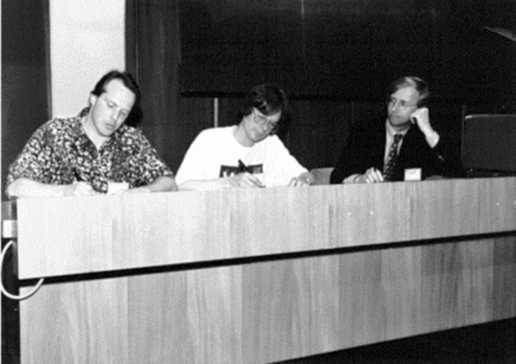
May 1994: The first World Wide Web conference is held in Geneva, with HTML+ on show
Although Marc Andreessen and Jim Clark had commercial interests in mind, the rest of the World Wide Web community had quite a different attitude: they saw themselves as joint creators of a wonderful new technology, which certainly would benefit the world. They were jiggling with excitement. Even quiet and retiring academics became animated in discussion, and many seemed evangelical about their new-found god of the Web.
At the first World Wide Web conference organized by CERN in May
1994, all was merry with 380 attendees - who mostly were from
Europe but also included many from the United States.
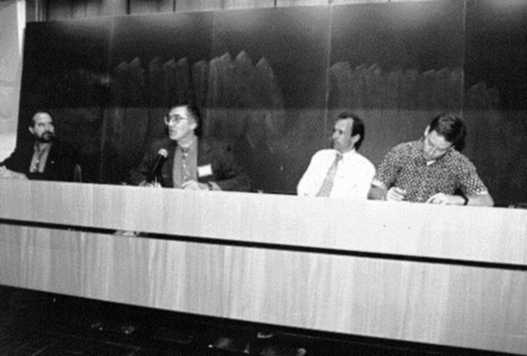
Dave Raggett had been working on some new HTML ideas, which he called HTML+. At the conference it was agreed that the work on HTML+ should be carried forward to lead to the development of an HTML 3 standard. Dave Raggett, together with CERN, developed Arena further as a proof-of-concept browser for this work. Using Arena, Dave Raggett, Henrik Frystyk Nielsen, Håkon Lie and others demonstrated text flow around a figure with captions, resizable tables, image backgrounds, math and other features.
September 1994: The Internet Engineering Task Force (IETF) sets up an HTML working group
In early 1994, an Internet Engineering Task Force working group
was set up to deal with HTML.
he Internet Engineering Task Force is the international standards
and development body of the Internet and is a large, open community
of network designers, operators, vendors and researchers concerned
with the evolution and smooth operation of the Internet
architecture. The technical work of the IETF is done in working
groups, which are organized by topic into several areas; for
example, security, network routing, and applications. The IETF is,
in general, part of a culture that sees the Internet as belonging to
The People. This was even more so in the early days of the Web.
he feelings of the good `ole days of early Web development are
captured in the song, The Net Flag, which can be found
`somewhere on the Internet'. The first verse runs as follows:
The people's web is deepest red,
And oft it's killed our routers dead.
But ere the bugs grew ten days old,
The patches fixed the broken code. Chorus:
So raise the open standard high
Within its codes we'll live or die
Though cowards flinch and Bill Gates sneers
We'll keep the net flag flying here.
In keeping with normal IETF practices, the HTML working group was
open to anyone in the engineering community: any interested computer
scientist could potentially become a member and, once on its mailing
list, could take part in email debate.
July 1994: HTML specification for HTML 2 is released
During 1993 and early 1994, lots of browsers had added their own
bits to HTML; the language was becoming ill-defined. In an effort to
make sense of the chaos, Dan Connolly and colleagues collected all
the HTML tags that were widely used and collated them into a draft
document that defined the breadth of what Tim Berners-Lee called
HTML 2.
November 1994: Netscape is formed
During 1993, Marc Andreessen apparently felt increasingly irritated at simply being on the Mosaic project rather than in charge of it. Upon graduating, he decided to leave NCSA and head for California where he met Jim Clark, who was already well known in Silicon Valley and who had money to invest. Together they formed Mosaic Communications, which then became Netscape Communications Corp. in November, 1994. What they planned to do was create and market their very own browser.Late 1994: The World Wide Web Consortium forms
The World Wide Web Consortium was formed in late 1994 to fulfill the potential of the Web through the development of open standards. They had a strong interest in HTML. Just as an orchestra insists on the best musicians, so the consortium recruited many of the best-known names in the Web community. Headed up by Tim Berners-Lee, here are just some of the players in the band today (1997):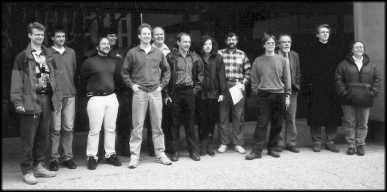
- Dave Raggett on HTML; from the United Kingdom.
- Arnaud le Hors on HTML; from France.
- Dan Connolly on HTML; from the United States.
- Henrik Frystyk Nielsen on HTTP and on enabling the Web to go faster; from Denmark.
- Håkon Lie on style sheets; from Norway. He is located in France, working at INRIA.
- Bert Bos on style sheets and layout; from the Netherlands.
- Jim Miller on investigating technologies that could be used in rating the content of Web pages; from the United States.
- Chris Lilley on style sheets and font support; from the United Kingdom.
The consortium is sponsored by a number of companies that
directly benefit from its work on standards and other technology for
the Web. The member companies include Digital Equipment Corp.;
Hewlett-Packard Co.; IBM Corp.; Microsoft Corp.; Netscape
Communications Corp.; and Sun Microsystems Inc., among many others.
Through 1995: HTML is extended with many new tags
During 1995, all kinds of new HTML tags emerged. Some, like the BGCOLOR attribute of the BODY element and FONT FACE, which control stylistic aspects of a document, found themselves in the black books of the academic engineering community. `You're not supposed to be able to do things like that in HTML,' they would protest. It was their belief that such things as text color, background texture, font size and font face were definitely outside the scope of a language when their only intent was to specify how a document would be organized.For More and Original History you can visit here "https://www.w3.org/People/Raggett/book4/ch02.html".
Okay, back to topic. The HTML language is basic and easy to understanding for everyone without exception. HTML language is need a basic structure code for build it.


0 comments:
Post a Comment